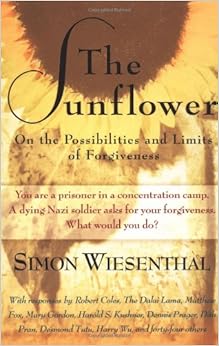
In his piece, The Sunflower, Simon Wiesenthal utilizes simile and motif to give his reader context for the question that he proposes. The first half of his book is made of an account of the events Wiesenthal went through during the Holocaust. He is a younger Jewish man being forced through intensive labor by the Nazis. One day, Wiesenthal is summoned by a dying Nazi soldier in a hospital room. The soldier breaks down and confesses to all of the horrible crimes he's regretfully committed during his time. He begs for the forgiveness of Wiesenthal - but Wiesenthal is overwhelmed and leaves the man without an answer.
Wiesenthal makes great use of simile, particularly to compare the Jews to animals. For example, when the Jews are led in a line along the streets, he explains that the people of the town "had become accustomed to the sight of tortured Jews and they looked at us as one looks at a herd of cattle being driven to the slaughterhouse" (13). In this case, the Jews are depicted as helpless beings being led to the deaths. Later, a young Jewish boy is spotted "collecting the crumbs which somebody had put out for the birds" (45). People look at the Jews as animals and the Jews must live like animals. Wiesenthal includes these inhumane comparisons to illustrate the harsh conditions of his people.
In addition, Simon Wiesenthal uses the sunflower as a motif. Hence the title of the book, sunflowers have awfully significant meaning to the narrator. He considers them a symbol of hope. However, he feels that he has no hope. Sunflowers are typically seen placed upon the graves of those lost - except the Jews whose bodies were thrust underground on top of each other. He questions the reason that "the murderer would own something even when he was dead," yet the living Wiesenthal received nothing. The sunflower is portrayed as something desired but seemingly impossible to obtain (to Simon).
His purpose in narrating up to this point is to give his audience - anyone interested in philosophy or ethics - as much of an idea as he can of his situation. Throughout the second half of his book, he will ask hundreds of different people what they would have done in his situation. His overall purpose of the entire text may very well change, but the first half was absolutely inserted for contextual reasons. By using devices such as simile and motif, the reader gains background information on the situation and from there can decide what they would do. Therefore, Wiesenthal would be considered successful in achieving his purpose.
Under what circumstances should we listen to the angel or the devil inside us? We may typically lean toward the angel, but what if the stakes are higher than imaginable? What if you were asked to forgive the man who killed your family? Or the man who beats you every single day? We do our best to be fair, but is there a point at which a line has been crossed and we must forget our morals?
Sunday, October 9, 2016
Sunday, September 25, 2016
TOW #3 - Am I Introverted, or Just Rude?
KJ
Dell’Antonia is a writer for the New York Times who considers herself a fierce
introvert. In her piece, Am I
Introverted, or Just Rude? she analyzes the mindset of the general
wallflower. She questions the motives behind any introvert: shyness versus
selfishness. She asks, “In a contest between my manners and my preferences, am
I allowing my preferences to win?” and
ponders over this through the remainder of the text.
Dell’Antonia wrote her piece after she was sent a link to a T-shirt that read, “Sorry I’m late, I didn’t want to be here.” Dell’Antonia associated with the quote; but she wasn’t too happy about it. She comes to the conclusion that she, along with many other introverts, only behaves in this fashion for personal gain – simply to avoid making an extra trip or spending her energy.
Dell’Antonia challenges her audience – her fellow introverts – to open up a bit and to change the manner in which the go about, assuming that these introverts are introverted for selfish reasons. Due to her subject matter, Dell’Antonia has automatic ethos, being an introvert herself. Her reflective, optimistic tone attempts to guide reader down her desired path of change. She uses personal anecdotes to provide concrete examples of how her introversion is not necessarily a good thing, and that stepping outside her shell has helped her grow as a person. She claims, “the knowledge that you might inadvertently be hurting someone’s feelings by not showing up or by behaving in a way that’s perceived as aloof can make it easier to extend yourself.” By this point in the piece, the reader has already seen the author mature.
In addition, Dell’Antonia uses allusion to reference professionals, such as psychologist Brian Little, to exemplify people who are introverted for the “right” reasons – their shyness. This example, as well as others, provides the reader some classification of introversion; it demonstrates the differences between social fear and selfishness. Dell’Antonia is successful in her supporting her analysis of human personality and trying to convince the reader to step outside their comfort zone to become more extroverted. She highlights the pros and cons of introversion, and the cons seem outweighing.
Dell’Antonia wrote her piece after she was sent a link to a T-shirt that read, “Sorry I’m late, I didn’t want to be here.” Dell’Antonia associated with the quote; but she wasn’t too happy about it. She comes to the conclusion that she, along with many other introverts, only behaves in this fashion for personal gain – simply to avoid making an extra trip or spending her energy.
Dell’Antonia challenges her audience – her fellow introverts – to open up a bit and to change the manner in which the go about, assuming that these introverts are introverted for selfish reasons. Due to her subject matter, Dell’Antonia has automatic ethos, being an introvert herself. Her reflective, optimistic tone attempts to guide reader down her desired path of change. She uses personal anecdotes to provide concrete examples of how her introversion is not necessarily a good thing, and that stepping outside her shell has helped her grow as a person. She claims, “the knowledge that you might inadvertently be hurting someone’s feelings by not showing up or by behaving in a way that’s perceived as aloof can make it easier to extend yourself.” By this point in the piece, the reader has already seen the author mature.
In addition, Dell’Antonia uses allusion to reference professionals, such as psychologist Brian Little, to exemplify people who are introverted for the “right” reasons – their shyness. This example, as well as others, provides the reader some classification of introversion; it demonstrates the differences between social fear and selfishness. Dell’Antonia is successful in her supporting her analysis of human personality and trying to convince the reader to step outside their comfort zone to become more extroverted. She highlights the pros and cons of introversion, and the cons seem outweighing.
Sunday, September 18, 2016
TOW #2 - Pamplona in July
Ernest Hemingway is considered one of the greatest
authors in history. Included in The Best American Essays of the Century is
his memoir, Pamplona in July. Hemingway has a gift in his descriptive
ability - the adjectives and verbs he uses make his writing absolutely
beautiful. His piece is all about his experiences from when he visited
Pamplona, Spain, to spectate the "Running of the Bulls," an annual
tradition held in the city where voluntary participants run through the streets
from several released angry bulls – for fun. He writes about the chaotic scenes
before the running began, specific people he encountered (and saw get thrusted
into the air by bulls), and some of his own opinions on the event (his pure
joy!). Through many connecting anecdotes and near-tedious narration, Ernest
Hemingway illustrates a perfect summer vacation.
Hemingway directs the memoir towards people searching for adventure and
new experiences in hopes of communicating his fondness and love for the Running
of the Bulls. He never would have written a memoir about a trip he didn't
enjoy. His first line captures interest by way of mere description: "In
Pamplona, a white-walled, sun-baked town high up in the hills of Navarre, is
held in the first two weeks of July each year the World's Series of bull
fighting" (1). He uses untraditional adjectives as he refers to the city
as “white-walled” and “sun-baked.” Throughout his piece, Hemingway also relies
heavily on metaphor to further his text. In addition, in order to make the
memoirs more personable, Ernest Hemingway uses sentence fragments, creating a
more informal yet focused tone. His whole piece is awfully nostalgic as he
essentially tries to sell a vacation to the reader and practically screams,
"Hey, you should check out Pamplona!" Hemingway is certainly
successful in his attempt to do this; whether it is his vivid description or
his passion that seems seeping through the pages, Pamplona and the Running of
the Bulls are depicted as something magnificent and not to be missed.
Sunday, September 11, 2016
TOW #1 - The Story Behind the Haunting 9/11 Photo of a Man Falling From the Twin Towers (Short Documentary)
In honor of September 11, TIME posted a four-minute documentary about the photo of "The Falling Man" which was taken during the 9/11 attacks. The image shows a man turned upside down with his arms by his sides, falling from one of the Twin Towers. The narrator of the documentary is the photographer himself, Richard Drew. I found myself sitting in silence as I watched the video. It seemed I couldn't blink or move or breathe - Yes, this may have been due to the fact that the topic was so emotional, but I'm used to hearing stories like this. The actual presentation of the information was what made the piece so breath-taking.
The first thing the viewer hears is some light piano playing behind a black screen, quickly setting an intense, heavy tone. Drew begins with an anecdote, describing his own memory of 9/11. He takes frequent, thoughtful pauses throughout the video, during which the producer strategically includes real-life sounds effects. For example, the sound of fire trucks, walkie-talkies and smoke are included, most likely to spark as much empathy out of the audience as possible. The piece was created for anyone who was alive during 9/11 or wants to learn about it - however, a disclaimer in the beginning warns viewers of "graphic images that may be disturbing."
And graphic images are indeed included. A remarkable scene in the video shows a whole photo library of different 9/11 victims plummetting from the Twin Towers. But the most mind-blowing of all the images was what was to become known as "The Falling Man." TIME posted the documentary, not just as an annual remembrance, but to further explore the meaning of the picture. However, the video does not show much evidence of this. The film seems to focus less on the photo's symbolism and more so on pure emotional appeal. In terms of the presentation, I would rate the documentary very highly, but as for the meaning and reaching a goal, I wouldn't consider it successful. Regardless, Drew's delivery combined with the producer's video-editing make for a jaw-dropping film.
The first thing the viewer hears is some light piano playing behind a black screen, quickly setting an intense, heavy tone. Drew begins with an anecdote, describing his own memory of 9/11. He takes frequent, thoughtful pauses throughout the video, during which the producer strategically includes real-life sounds effects. For example, the sound of fire trucks, walkie-talkies and smoke are included, most likely to spark as much empathy out of the audience as possible. The piece was created for anyone who was alive during 9/11 or wants to learn about it - however, a disclaimer in the beginning warns viewers of "graphic images that may be disturbing."
And graphic images are indeed included. A remarkable scene in the video shows a whole photo library of different 9/11 victims plummetting from the Twin Towers. But the most mind-blowing of all the images was what was to become known as "The Falling Man." TIME posted the documentary, not just as an annual remembrance, but to further explore the meaning of the picture. However, the video does not show much evidence of this. The film seems to focus less on the photo's symbolism and more so on pure emotional appeal. In terms of the presentation, I would rate the documentary very highly, but as for the meaning and reaching a goal, I wouldn't consider it successful. Regardless, Drew's delivery combined with the producer's video-editing make for a jaw-dropping film.
Tuesday, September 6, 2016
IRB Intro #1 - The Sunflower (Simon Weisenthal)
For the first marking period and for my first IRB, I am choosing to read The Sunflower, by Simon Weisenthal, a Jewish Austrian Holocaust survivor.
The Sunflower is split into two parts. First, the author takes us through an emotional story of a Nazi soldier who begs for forgiveness from the Jews for his actions. This alone sounds fascinating. However, throughout the rest of the book, different, more current people of unique backgrounds respond to Weisenthal's situation. I'm hoping that all of their perspectives reach me and make me think.
My rationale for selecting this book was relatively simple: I am Jewish and thus, I have an interest (and feel a sort of connection) in tales about the Holocaust. I've never heard of a story such as The Sunflower and am looking forward to reading it!
The Sunflower is split into two parts. First, the author takes us through an emotional story of a Nazi soldier who begs for forgiveness from the Jews for his actions. This alone sounds fascinating. However, throughout the rest of the book, different, more current people of unique backgrounds respond to Weisenthal's situation. I'm hoping that all of their perspectives reach me and make me think.
My rationale for selecting this book was relatively simple: I am Jewish and thus, I have an interest (and feel a sort of connection) in tales about the Holocaust. I've never heard of a story such as The Sunflower and am looking forward to reading it!

Saturday, August 27, 2016
The Disposable Rocket - John Updike
Title: The Disposable Rocket
Author: John Updike
The author of the piece, John Updike, attended Harvard University where he focused on art and writing. He is famous for his short fiction stories, but the skill he is best known for his ability to express himself (even if it is blunt). His essay, The Disposable Rocket, is a fictional essay comparing the male body to the female body. He wants to convey to his audience – most likely males – that the male body is incredibly graceful and interesting.
Early on, Updike writes an anecdote about his childhood: “I used to fall and jump just for the joy of it. Falling – backwards, downstairs – became a specialty of mine” (paragraph 2). He uses this to transition to the idea that the only thing that seems to harm the male body is physical activity – that is, sports. He explains that his “hobby” of falling was one that took a toll on his body.
He goes on to discuss the longevity and intricacies of the male. He uses various metaphors to describe the male’s genitals: “a demon of sorts has been attached to their lower torsos, whose performance is erratic and whose errands, at times, seem ridiculous” (paragraph 5). He describes a fascinating sort of disconnect within the male body; Updike considers there to be two people within the male. However, as the essay progresses, Updike describes that this “disconnect” is something beautiful and is something to be appreciated. He uses personification to further characterize the body itself, which again assists him in sending his message.
John Updike successfully delivers his message. Although the male body can be unpredictable, if treated properly, it can last a long time. His essay was quite a strange one, about an awfully uncomfortable topic, but his bluntness and ability to get his points across in as little words possible make for a special piece.
We evolved like this for a reason.
Insert Flap "A" and Throw Away - S.J. Perelman
Title: Insert Flap "A" and Throw Away
Author: S.J. Perelman
Insert Flap “A” and Throw Away is a humorous essay by S.J. Perelman, a 20th century writer and humorist. His piece is a fiction with an unknown time or place. It is written to simply entertain the reader – it seems Perelman’s goal is to get a chuckle from his audience. The writing seems to be intended for anyone willing to take a look at it – though one could say that it is meant for people looking to laugh.
The story is a narration, an account of the main character’s shortcomings. From the beginning until the final few paragraphs, the narrator (who writes in first person) tries teaching groups of children how to build various items: the “Jiffy-Cloz” and “Self-Running 10-Inch Scale Model Delivery Truck Construction Kit,” for example. Unfortunately, every single attempt ends in failure.
Perelman writes using satire – in the first paragraph when introducing the first thing he fails to build, he writes that he learned, “the shortest, cheapest method of inducing a nervous breakdown ever perfected” (paragraph 1) This sets the reader up for an interesting story, to say the least. He uses dialogue to add a more personal dimension. He asks a child to hand him a knife but the child refuses for safety reasons. The narrator gets a knife on his own a sentence later, the book reads that the narrator is “in the bathroom grinding his teeth in agony and attempting to stanch the flow of blood” (paragraph 11). Little, unexpected moments like these keep Perelman’s piece exciting.
In the very end, the narrator wakes up. It turns out that he has been in some sort of mental institution and he was dreaming. The story ends with the doctor instructing that the man does some exercises with his hands – exactly what seems to have gotten him into trouble in the first place.
The author is successful in accomplishing his purpose, which was really just to make the reader laugh. There were several moments where I had to reread sentences because they were so ridiculous. Using a very informal tone, S.J. Perelman writes a unique, memorable, cliff-hanging essay.
Nightmare... or reality?
Subscribe to:
Posts (Atom)